

A leak in a commercial flat roof does not drip into a bucket, it lands on a tenant’s desk, a stockroom floor, or a dental operatory, and the building keeps running while it happens. Most of the commercial buildings in the Eau Claire area carry a flat or low-slope roof, and the same membrane systems that protect a strip center along Clairemont Avenue also protect the low-slope porch, addition, or modern-design section on a house. This page covers both: how the systems compare, where they fail in a Wisconsin winter, when to repair, recover, or replace, and what each path costs.
We work commercial and flat roofing across the Chippewa Valley, from standalone retail through warehouses and light industrial. The honest exception: hospital systems and buildings with complex multi-layer engineering requirements call for a firm with on-staff engineering, and we will refer you to one rather than learn on your roof.
Flat roof systems compared: TPO, EPDM, modified bitumen, and metal
- TPO (thermoplastic polyolefin) is the most-installed membrane on new commercial flat roofs today, and the reason is the seams. TPO sheets are joined with hot air: the welder melts the two sheets into each other, and the cooled seam is one continuous piece of membrane. Taped and glued seams depend on bond chemistry holding up for decades, and aging seams are the classic failure on a 20-year-old flat roof; a welded seam does not have that clock running. Thickness is the spec decision: 45, 60, and 80 mil, thicker meaning better puncture resistance against hail and foot traffic. We spec 60 mil on most jobs and step up to 80 where rooftop traffic or hail exposure justifies it. Attachment is the other choice: mechanically attached (plates and fasteners under the welded laps) installs faster and costs less; fully adhered costs more but resists wind uplift better and lays flatter. The white surface gets the marketing attention, and the cooling effect in July is real, but reflectivity matters less in Wisconsin than in the South. Lifespan 20 to 30 years. Our default commercial spec.
- EPDM (rubber) is a black sheet membrane with seams joined by tape and adhesive, and a track record going back to the 1970s. It handles UV well, resists chemicals, and stays more flexible than TPO in cold weather, which matters in a Wisconsin January. Lifespan 25 to 30 years. We install it where an owner prefers rubber, on residential porches where black suits the house, and on buildings with chemical exposure.
- Modified bitumen is asphalt-based membrane, the modern successor to built-up tar roofs, in two or three layers fused by torch or self-adhered. It takes foot traffic well, which makes it the choice for roofs where HVAC gets serviced every month. Lifespan 15 to 25 years.
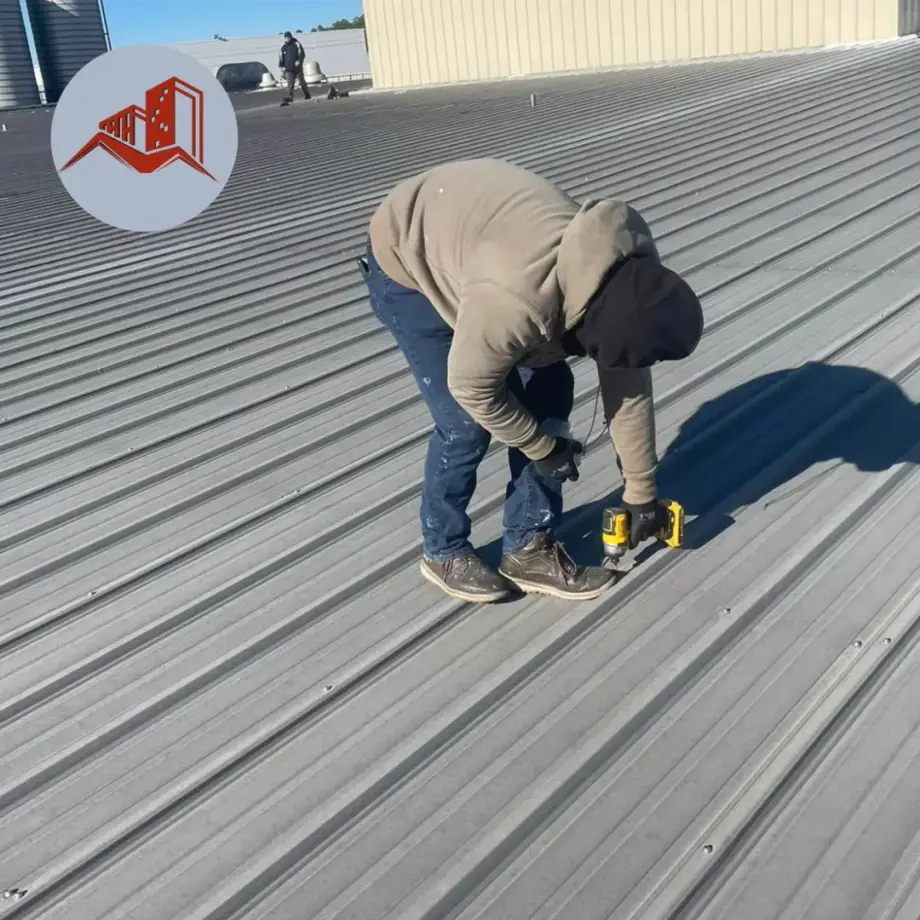
- Standing seam metal covers industrial buildings, agricultural facilities, and architectural-feature commercial. Lifespan 30 to 40 years and beyond, with less maintenance than any membrane; the metal roofing page covers the panel systems.
- Built-up tar and gravel is what most people picture when they hear “flat roof,” and it is what many of the older storefront buildings downtown still carry. We do not install new built-up; modern membranes outlast it. We maintain, repair, and recover existing built-up roofs, and eventually tear them off.
Where flat roofs fail in an Eau Claire winter
Flat roofs rarely fail in the field membrane. They fail at the details, and a Wisconsin winter works every one of them:
- Penetrations. Vent stacks, drains, skylights, HVAC curbs. The flashing at every penetration has to be right and re-checked over time. This is the most common leak source on an otherwise sound roof.
- Seams on older systems where the tape or adhesive has aged. Twenty-year-old EPDM with taped seams is the usual case; welded TPO seams do not have this problem.
- Edge metal. The perimeter detail where the membrane terminates against a wall or fascia. UV and thermal cycling work this joint hard, and a winter here swings a roof through dozens of freeze-thaw cycles.
- Ponding water. Water standing in low spots ages membrane faster than anything else, and in winter it becomes an ice sheet that lifts seams and cracks flashing. A drain that freezes shut in December holds a whole thaw’s worth of water in March.
- Mechanical damage from foot traffic, fallen branches, or solar and HVAC installs done without walk pads.
The warning signs arrive in a readable order. Ponding that has not drained 48 hours after rain is the earliest: often a one-day drain cleanout, sometimes a sagging substrate. Bubbles or blisters mean trapped moisture or air; a few are repairable, widespread blistering means the system is delaminating. Cracking or alligatoring on older modified bitumen and EPDM is the polymer breaking down, and puts replacement on the radar within one to three years. Seam separation on a system older than fifteen years is the classic end-of-life mode. Inside the building, ceiling stains under a flat section, a mildew smell after rain, and paint bubbling on the walls beneath all count. The high-risk moments here are spring, after snow load and freeze-thaw, and fall, before the next freeze cycle starts.
Repair, recover, or replace
Most commercial roofs reach end-of-life through neglect rather than age. A 20-year roof gets to 28 or 30 years with maintenance; the same roof gets to 17 if no one looks at it between leaks. So the first question is always which of three paths the roof is on:
| Path | When it is the answer | What it buys |
|---|---|---|
| Repair | One failed penetration, a puncture, an isolated seam tear on a sound system | The rest of the roof’s life, for hundreds not thousands |
| Recover | Membrane sound and dry, insulation dry, one existing layer, structure can carry the weight | Another 15 to 20 years at 30 to 40% below replacement cost |
| Replace | 25% or more of the membrane failed, scattered leaks, soft decking, or a carrier flag | A 25 to 30 year reset on a known system, with the insulation brought to current code |
Repair is the answer for localized damage: a single failed penetration, a puncture, an isolated seam tear. Patching with a compatible membrane and the right adhesive or weld is straightforward and lasts. What does not patch well is failed seams across larger sections, widespread UV degradation, or membrane that has been coated with incompatible products. Widespread small issues (several penetrations failing, edge metal pulling away in more than one spot, surface alligatoring) mean repair keeps the roof going, but a replacement budget belongs on the radar within two to five years.
Recover means a new membrane installed over the existing roof without tearing it off, and it saves 30 to 40% of replacement cost when the conditions support it; the recover versus replace guide goes through those conditions and the moisture survey that tests them. They have to all be true: the existing membrane is sound and dry, the insulation underneath is dry and not compressed, the building has only one layer up there now, and the structure can carry the added weight. Wet insulation under a recover traps moisture and ruins the new system; two existing layers mean the code requires a tear-off. Recover typically buys 15 to 20 years; a full tear-off and replacement resets the clock to 25 to 30 on a known system. Which is cheaper per year depends on how long you will own the building.
Replace when any of these is true, in order of certainty: 25% or more of the membrane has failed and repairs have become patchwork; leaks are showing up in scattered locations rather than one spot, which signals systemic breakdown; the decking has soft spots or sag; or your insurance carrier has flagged the roof, which some do on roofs past 20 years without a recent inspection.
Two rules from the code shape the replacement path. A commercial re-roof in Eau Claire is permitted work under the state commercial building code, not the dwelling code, and the permit runs through the city. And whenever a tear-off exposes the roof insulation, the energy code requires bringing that insulation up to the current minimum before the new membrane goes on, which is one reason a tear-off costs more than a recover and one reason the building’s heating bill usually drops afterward.
Commercial roofing cost in Eau Claire
Commercial replacement work runs $8 to $18 per square foot installed, depending on system, thickness, attachment, accessibility, and tear-off scope; a 5,000 sq ft commercial re-roof typically lands between $35,000 and $75,000, with the energy-code insulation upgrade the biggest single swing inside that range. Flat sections on homes run $7 to $16 per square foot; a 200 sq ft porch or addition roof usually lands $1,500 to $3,000. Off-hours and weekend work, when a business needs continuity, costs 15 to 25% more than standard scheduling because of crew overtime.
On the maintenance side, a single inspection runs about $300 to $500 for a typical commercial building, and a semi-annual maintenance agreement runs $400 to $1,500 a year depending on roof area and the number of penetrations. The issues caught on a $400 inspection are the same ones that become $5,000 to $15,000 reactive repairs when missed: a clogged drain that holds water through a whole season, failed sealant at a penetration, flashing lifting at the edge, a puncture from a service tech’s dropped tool.
Tax framing worth raising with your accountant: a full replacement is typically a capital expense, depreciated over 39 years for nonresidential property, while maintenance is an operating expense deductible in the year it is incurred.
Buildings we work on
Retail strip centers and standalone retail, with multi-bay roofs and tenant-driven decisions. Small offices and professional buildings, usually one system on one roof. Medical and dental offices, where uptime rules and we run containment for dust. Light industrial and warehousing, with equipment-heavy interiors. Churches and community buildings, often older, often carrying two generations of roof and a tight budget. Restaurants, with grease exhaust, heavy rooftop equipment, and hygiene rules during repair. Auto dealerships and service centers, frequently a mix of metal and membrane sections. And the older two- and three-story storefronts downtown, where a built-up roof behind a brick parapet drains through internal drains and scuppers that need checking before every winter.
Flat and low-slope sections on Eau Claire homes
Most houses here do not have a fully flat roof, but plenty have a flat or low-slope section: a porch or portico, the connecting section of a sunroom addition, a mudroom, the wing between two pitched volumes. Mid-century homes with shed profiles and boxy contemporary builds that use the flat roof as design show up across the Chippewa Valley too. Those sections need a membrane, not the asphalt shingles on the rest of the house, because shingles cannot shed water reliably below a 2/12 pitch. True dead-flat roofs are rare; a properly built flat roof still slopes at least a quarter inch per foot toward its drains.
For a typical residential porch or addition, our default spec is fully adhered EPDM with proper edge metal and a clean termination at the wall, because the black membrane suits most houses and the system forgives an uneven substrate. For modern homes that use the flat roof as a design element, TPO in standard or off-white delivers the reflectivity without the dirt-collecting problem of pure white over time. These small sections are also the ones that fail quietly for months before anyone notices, which is why a five-minute look from a window every spring and fall is worth the trouble.
Free roof asset assessment and maintenance plans
Before we quote any work we do a roof asset assessment: free, no obligation, with a written report you can use for capital planning whether or not you hire us. It covers system identification (what is up there, roughly when it went on, what shape it is in), a remaining-life estimate framed as a two- or three-year window rather than a false-precision number, a drainage analysis of slopes, drains, scuppers, and gutters with any ponding flagged, the condition of every penetration and flashing point, and a recommendation (repair, maintenance plan, recover, or replacement) with rough budget ranges for each. Owners with several buildings use it for portfolio planning.
Maintenance after that is two inspections a year, spring and fall, plus a visit after any major storm. Each visit works the same list: sealant at penetrations, membrane pulling away from edge metal or wall transitions, debris in drains and scuppers, and any damage around rooftop equipment from the last service call. Manufacturer system warranties, typically 15 to 30 years depending on membrane thickness and attachment, require a certified installer and a full-system spec; we register them at completion and coordinate any claim later.
Re-roofing a building that stays open
Nearly every commercial roof replacement happens with the business open, and the variables get settled before we mobilize: which hours the noisiest phases run (some owners want them off-hours, some want continuity), how we route crew and dumpster away from customer entrances, coordination with the HVAC contractor when rooftop units are involved so the systems stay running, and containment plus dust suppression for medical, food service, or sensitive inventory. Tear-off makes noise and dust on the floor below, so we tarp interior areas where it matters and cordon off any roof edge where falling material is a risk.