
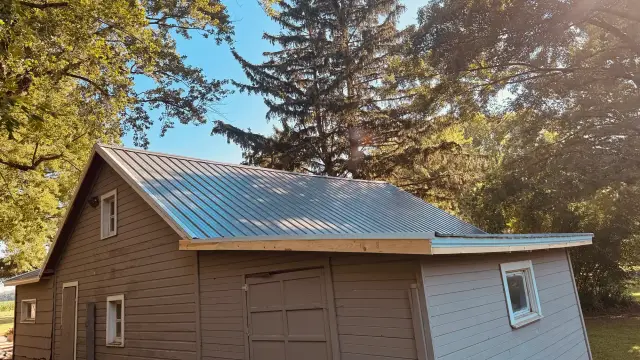
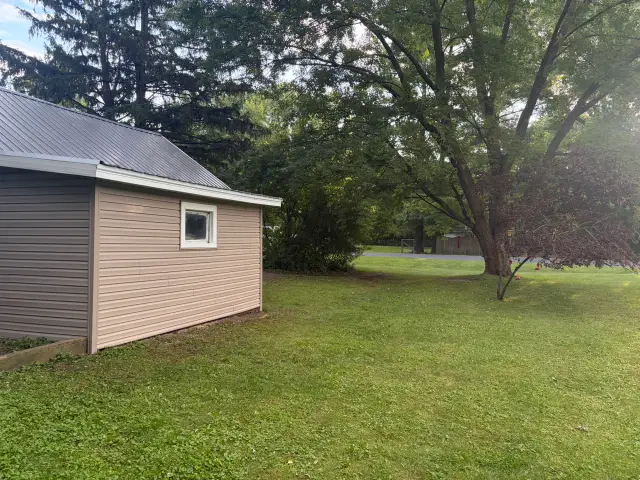
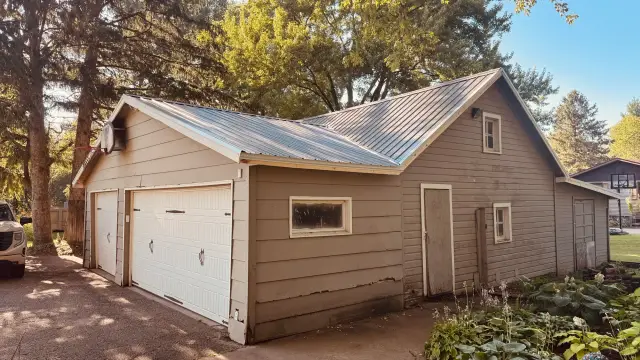
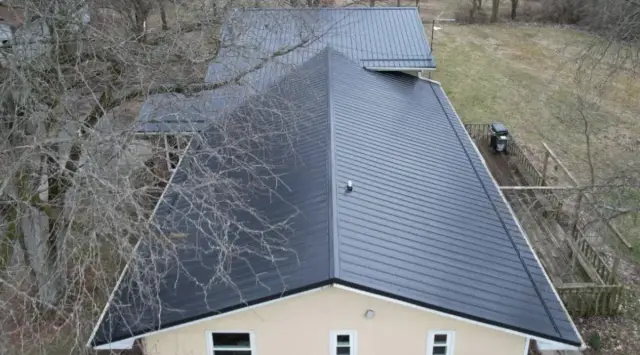
Metal is the roof you buy once. It costs roughly twice what asphalt costs on the same house, lasts two to three times as long, and behaves differently in a Wisconsin winter: snow slides instead of sitting, and there is no shingle edge for an ice dam to work under. Whether that trade is worth it depends on how long you are staying, what the house looks like, and what is under the eaves, and this page lays out that decision the way we lay it out on a driveway.
Standing seam, exposed fastener, metal shingles, and stone-coated steel
Metal roofing is a category, not a product, and the four systems sit at very different price points.
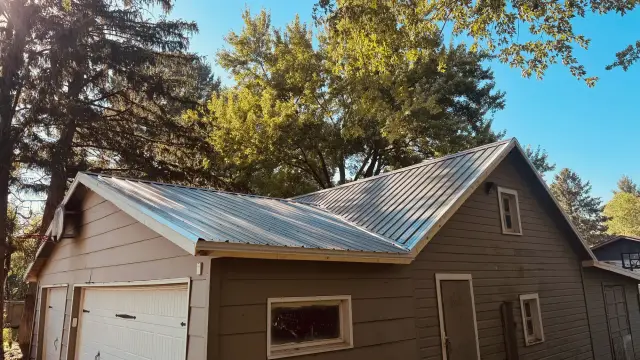
Standing seam is the residential system. Vertical panels with raised seams that snap together or get mechanically seamed, with every fastener hidden under the seam where sun and weather cannot reach it, which is why it outlasts the cheaper options. Common profiles are the 1.5-inch mechanical lock and the 1-inch snap-lock. Most of the metal we put on houses is standing seam.
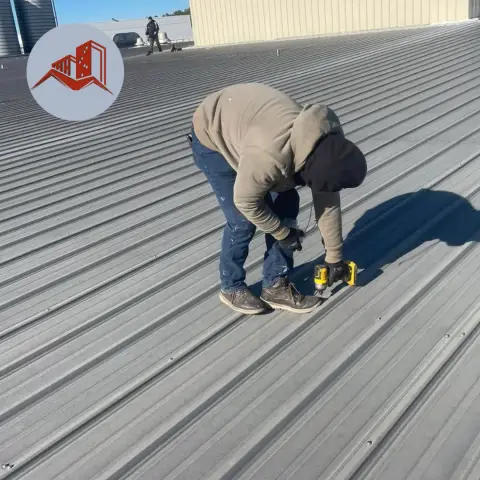
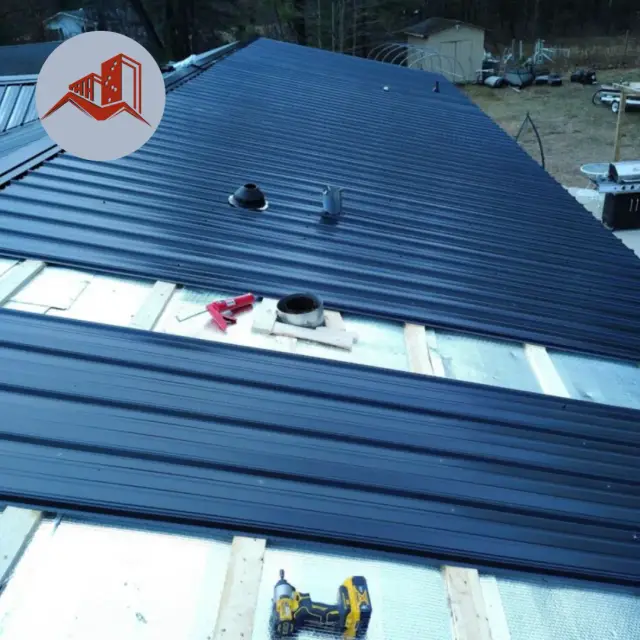
Exposed-fastener panel (R-panel, ag panel, ribbed steel) is the workhorse on barns, machine sheds, pole buildings, and garages. Screws go through the panel face into purlins or decking. It installs fast and costs a fraction of standing seam, but the rubber gaskets under the screw heads dry out and start weeping at 15 to 20 years while the panels themselves go on for decades, so an exposed-fastener roof gets a re-gasket pass midway through its life. Excellent on outbuildings; on the house we steer people to standing seam.
Metal shingles and tiles are pressed steel that reads as dimensional shingle or slate from the street. A niche product for houses whose architecture wants a traditional look with metal’s lifespan.
Stone-coated steel has crushed stone baked onto the panel and looks like tile or shake from the curb. Long-lived, premium-priced, and less common here than in the Sun Belt where it started.
When metal makes sense in the Chippewa Valley, and when it doesn’t
Metal is not always the right answer, and the “metal is always better” pitch skips the cases where asphalt wins. Metal makes sense when:
- You are staying 20 years or more. A standing seam roof installed correctly outlasts most owners’ time in the house, and the 40 to 50 year lifespan is what amortizes the upfront premium: if you would re-roof asphalt twice in the time metal lasts once, metal is cheaper per year of ownership.
- The winters have been a problem. Metal sheds snow instead of carrying it through January and February, and with snow guards it releases in metered slides rather than one slab. If you have fought ice dams that ventilation fixes did not solve, metal removes the shingle edge the dam forms under.
- The architecture suits it. Standing seam in charcoal or a deep green is the right look on a modern build, a country property, or an outbuilding in a way asphalt never quite reaches.
- Hail is on your mind. Hail dents on metal are usually cosmetic; hail on asphalt often means a full replacement claim. Light colors also reflect summer heat instead of absorbing it, and the panels weigh roughly half what asphalt does per square foot, so a house that carried asphalt almost never needs structural work to carry metal.
Metal does not make sense when:
- You are selling within ten years. Buyers pay something for a metal roof, but rarely the full upgrade premium.
- The pitch is under 3/12. Panels have minimum slope requirements; below that, a membrane from the commercial and flat roofing page is the right system.
- The house is a Victorian, a colonial, or a period bungalow. Metal looks wrong on those styles no matter how clean the install.
- An HOA restricts roof materials, which some newer subdivisions around Eau Claire do; we pull the guidelines before the estimate.
- The budget is stretched. Architectural asphalt at $13,000 is a better outcome than standing seam at $30,000 carried on a seven-year loan.
Metal roofing cost in Eau Claire
Rough numbers for the systems above, on a typical house or outbuilding:
| System | Typical cost | Where it belongs |
|---|---|---|
| Standing seam, average residential home | $14,000 to $24,000 | Houses, hidden fasteners, the roof you buy once |
| Standing seam, larger or steeper roof | $20,000 to $35,000 | Two-story and cut-up rooflines |
| Exposed-fastener panels | $9,000 to $15,000, about $3 to $8 per square foot installed | Barns, machine sheds, pole buildings, budget residential |
| Stone-coated steel | $25,000 to $45,000 | Houses that want a tile or shake look with steel’s lifespan |
That is 1.5 to 2 times what the same roof costs in asphalt, and the roof replacement page carries the asphalt figures for comparison. The drivers are the same as any roof, square footage, pitch, and complexity, plus one that is specific to metal: every wall, chimney, skylight, and valley needs a fabricated trim piece, so a cut-up roof costs more in metal than its footprint suggests. Bundling a house and an outbuilding into one mobilization trims the total by 10 to 20%, which is why farm jobs often run both at once.
How a metal roof goes on: underlayment, expansion, and snow guards
A bad metal install leaks within a few years; a good one lasts decades, and the difference is in details you cannot see from the curb.
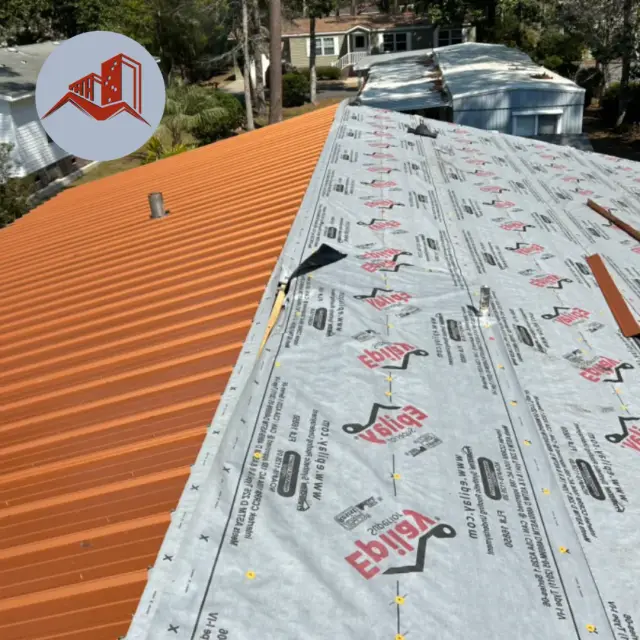
- High-temperature ice and water membrane. Standard ice-and-water shield can soften at the temperatures a metal panel reaches in July. We use high-temp membrane rated for use under metal at every eave and valley. Wisconsin’s ice-barrier code rule is written for shingle roofs; on metal we run it regardless, because the eaves here ice up either way.
- Synthetic underlayment over the whole deck, seams lapped, and the specific underlayment a manufacturer names when its warranty requires one.
- Clips that let the panels move. Steel expands and contracts more than asphalt across a Wisconsin year, and the clip system has to allow it. Panels pinned in place buckle and oil-can.
- Snow guards or rail retention on any pitch over 4/12 with a driveway, walkway, deck, or air conditioner below the eave. On the tight lots in Eau Claire’s older neighborhoods the snow has to land somewhere, and a slab off a 12/12 slope lands on the neighbor’s walk. Cheap installs skip the guards; expensive cleanups follow.
- Flashing at every transition. Walls, chimneys, skylights, and plumbing vents are where metal roofs leak, and each one needs its own fabricated detail.
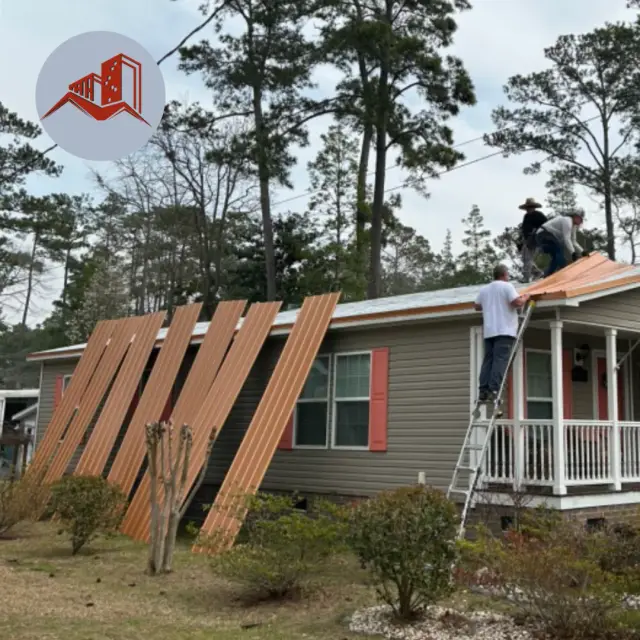
A standing seam install on a typical house runs two to four days: deck prep and membrane the first day, panels cut to length on site and hung the second, trim and snow retention after. The permit is the same building permit as any re-roof in your municipality; the roof replacement page lists the rules town by town. Metal can go on in winter on a dry day, which asphalt cannot, so it is also the system we install when a roof will not wait for spring.
Colors, profiles, and the panels we install
The standing seam colors we install most in the Chippewa Valley, roughly in order: charcoal gray, which works with nearly every siding; Hartford green on farmhouses and country homes; regal red on white-sided farmhouses; slate and gallery blues on modern builds; and burnished slate where someone wants a subtle metallic sheen. Snow guards, ridge caps, and end-wall flashing all get color-matched on the estimate, and we bring physical panel samples so you can see the color against your siding in your own sunlight rather than in a brochure.
Profiles come in two families: snap-lock systems, which install faster and cost slightly less and suit most houses, and mechanical-seam systems, which install slower, seal tighter, and go on lower pitches and higher-end work.
For residential panels we install ABC Seamless and Central States most often; both have cold-climate track records and finishes that hold their color under UV. For larger commercial work, McElroy Metal is the standard.
Metal roof warranties
A metal roof carries three warranties, and it helps to know which is which. The finish warranty covers the paint against chalking and fading, commonly 30 to 40 years on the PVDF (Kynar) coatings used on residential standing seam. The substrate warranty covers the steel itself against rust-through. And the workmanship warranty covers the installation, which is where most metal roof problems in the first decade come from: it runs five to ten years on our work, in writing on the estimate, the same as any replacement we do. Some manufacturers only honor the finish and substrate warranties when their named underlayment and clip system are used, which is one reason the spec on the estimate is specific to the panel system.