

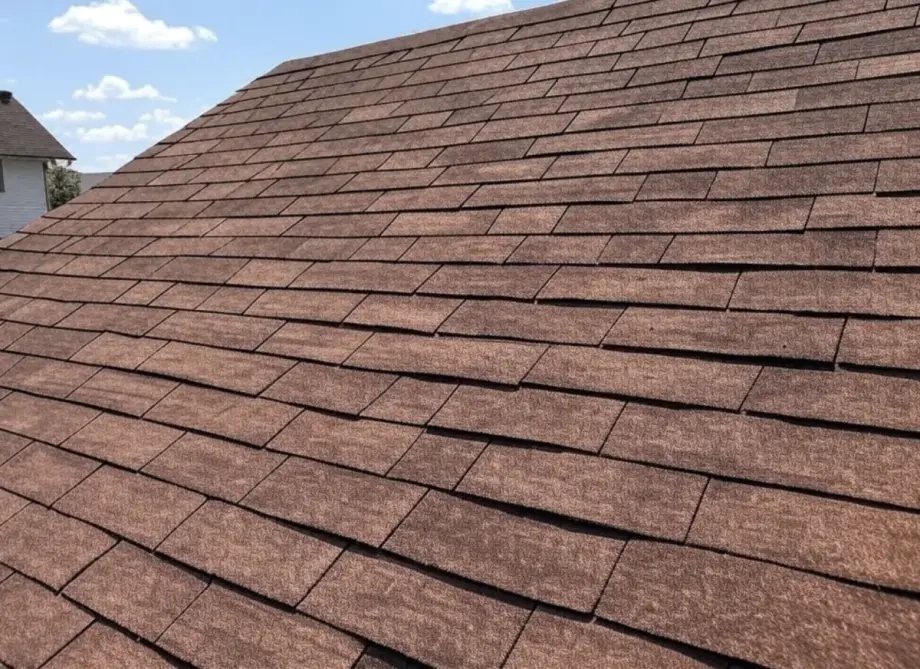
On most replacements in the Eau Claire area the question is not whether to use asphalt shingles but which ones: architectural or 3-tab, which manufacturer’s line, standard or impact-rated, and what color against your siding. Eight of ten houses here wear asphalt because it costs the least per square foot of any roof we install and lasts 25 to 30 years when the attic underneath it is vented properly. This page is the decision, plus the installation details that decide whether your roof gets those years.
Architectural vs 3-tab shingles
| Architectural (dimensional, laminate) | 3-tab | |
|---|---|---|
| Construction | Two or more layers, shadow lines and depth from the curb | Single flat layer |
| Lifespan here | 25 to 30 years with a proper install | 15 to 20 years |
| Wind rating | 110 to 130 mph | 60 to 80 mph |
| Cost | Baseline | About 20 to 25% less |
| Warranty | Limited lifetime, prorated after ten years | Shorter, product-dependent |
The rows of lifted tabs after a spring wind event are almost always 3-tab, which is the wind-rating line in that table showing up on a roof. 3-tab is fine on a barn or shed. On a house you plan to keep, the small savings do not justify the shorter life and the blow-offs, and nearly every replacement we do in the Chippewa Valley is architectural.
Which shingle to pick: CertainTeed, GAF, or Owens Corning
Three axes actually drive the choice, warranty length, wind rating, and look; everything else is marketing. The lines we install most often:
- GAF Timberline HDZ is the default for most Eau Claire homes: the most-installed shingle in North America, a solid wind rating, a broad color range, LayerLock construction that handles freeze-thaw well, and mid-range pricing, so you are not paying for a name.
- CertainTeed Landmark when you want a longer warranty (Landmark Pro steps up from limited lifetime to 50-year non-prorated) or a steep roof where the higher wind rating earns its keep. Landmark’s color depth reads a little richer than GAF; pricing is comparable.
- Owens Corning Duration when algae resistance matters. Its SureNail strip gives it strong wind performance, and its StreakGuard granules hold off the dark streaking that grows on shaded north slopes.
All three are good shingles, and color availability and current pricing usually settle it. Two upgrades sit on top of the base choice. Class 4 impact-rated versions of the same lines carry a thicker, more impact-resistant mat; they cost roughly 15 to 25% more and earn a discount of about 5 to 15% on the wind and hail portion of many Wisconsin policies, which after the four-inch hail that hit Eau Claire County in May 2025 is worth running the numbers on. Designer-grade shingles run $30 to $50 per square more and look noticeably more dimensional; worth it on a Tudor or a high-end traditional home where the roof is a feature, not worth it on a ranch or split-level where the difference never shows.
Where asphalt shingles fail in the Chippewa Valley
Knowing how shingles die here tells you which details matter on the install.
- Cooked from below. An under-vented attic is the leading cause of premature shingle failure in this area. Summer heat trapped under the deck bakes the asphalt mat, and the shingles curl and shed granules years early. Many older Eau Claire homes have exhaust vents and no working soffit intake, which is the same imbalance that builds ice dams in January.
- Ice dams at the eaves. Snow melts over the warm attic, refreezes over the cold overhang, and the pond behind the ridge of ice backs up under the shingles. The membrane under the first courses is the only thing between that water and the ceiling.
- Wind at the edges. Rake and eave courses lift first, then the field. Fastening pattern and a proper starter strip decide it.
- Algae streaking on shaded slopes. The dark streaks that show up on north-facing roofs along the river valleys, where slopes stay damp, are Gloeocapsa magma, an airborne algae that feeds on the limestone filler in the shingle. It is cosmetic for years before it is anything else, and the algae-resistant lines with copper or zinc granules hold it off for 10 to 15 years.
- Nail pops and thermal cracking as the deck moves through decades of freeze and thaw, each raised head a future leak.
Installing shingles to Wisconsin code, and beyond it
What separates a good asphalt install from a cheap one is invisible from the street:
- Ice and water membrane. Wisconsin’s dwelling code requires an ice-dam membrane only on shingle roofs pitched 4:12 or flatter, running 30 inches up from the edge and at least a foot past the inside face of the exterior wall. That is the floor, not the spec. We run it at every eave, in every valley, and around every chimney, skylight, and vent on every pitch, because the ice dams here do not check the code first.
- Synthetic underlayment across the whole deck. Felt is still allowed and still slower and weaker.
- Drip edge on eaves and rakes. Cheap material; skipping it is a sign of a cut-rate crew.
- A factory starter strip along the bottom edge so the first course seals. Reversed field shingles as starter leave gaps.
- Six nails per shingle wherever the manufacturer’s high-wind pattern applies, which is most roofs in this county. Four is the minimum; six is what holds a 90 mph gust.
- Balanced ventilation. The state code sets attic ventilation at 1/300 of the ceiling area when at least half of it sits high on the roof, split between soffit intake and ridge or static exhaust. On a replacement we correct the intake side where it is missing, because exhaust without intake is how a roof both bakes and ices.
- Matching hip and ridge cap with venting built in where it belongs; cut-up field shingles as cap fail faster.
The tear-off itself, the decking check, the permit, and the day-of sequence are the same as any roof replacement, and that page walks through all eight steps, the Eau Claire permit rule, and the timeline. An asphalt replacement on a typical house is one to two working days once the weather cooperates; shingles do not seal below 50°F, so the season runs roughly April into November.
Asphalt shingle colors
The most popular colors in the Eau Claire area, roughly in order: weathered wood and driftwood (neutral browns and grays that suit most siding), pewter and charcoal (darker grays on modern homes and white siding), slate and chateau gray with a blue undertone, hickory and brown blends, and black on high-contrast modern designs. Weathered wood, charcoal, and driftwood are also the resale-safe choices; a color that looks current now can look dated to the next buyer, and loud reds and greens only work when the architecture asks for them. We bring physical sample boards to the estimate, because a shingle looks different in your sunlight against your siding than it does in a brochure or in the truck.
What an asphalt shingle roof costs in Eau Claire
A typical two-story Eau Claire home in architectural shingles lands at $11,000 to $16,000; a simple single-story runs $9,000 to $12,000, and steep, complex, or premium-shingle roofs run to $28,000 and up. Shingle grade and roof complexity drive the spread far more than the manufacturer does. The roof replacement page breaks the tiers down, and a free estimate turns them into the actual number for your roof.