

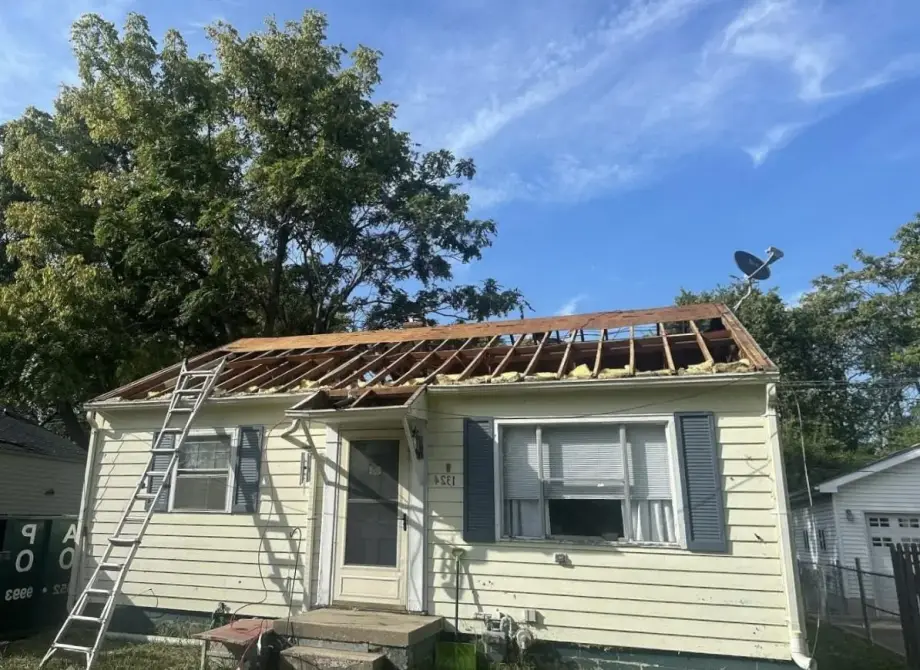
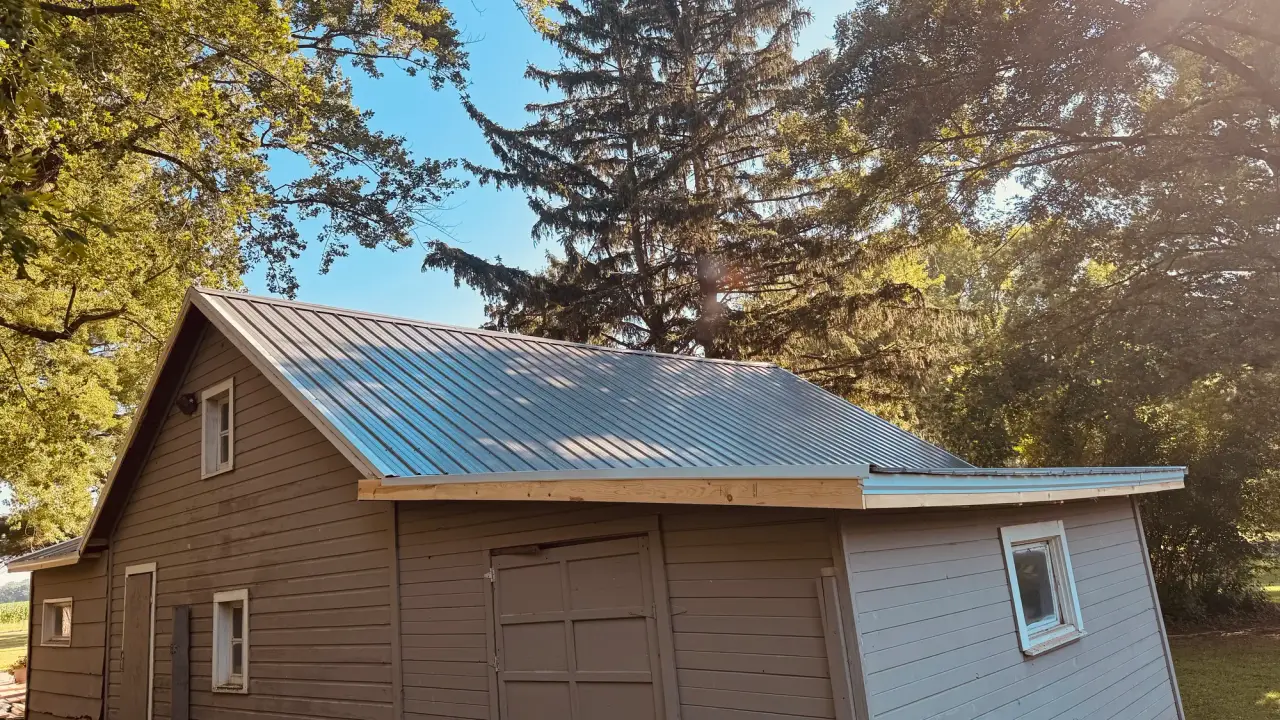
Augusta’s roofing is farm-first. The village is small, but the Town of Bridge Creek around it holds the real square footage: dairy barns, machine sheds, pole buildings, and grain storage, mile after mile of working steel. That is why our Augusta runs so often carry metal roofing panels in the trailer rather than shingle bundles, and why the first question on the phone is the whole roof inventory. One crew handles the property: ribbed steel on the outbuildings, asphalt or standing seam on the house, quoted as one project.
Barn and machine-shed roofs around Bridge Creek
Agricultural steel has its own failure calendar, and it starts at the screws. Exposed-fastener panels shrug off decades of weather, but the neoprene gaskets under the screw heads bake out and turn every screw line into a drip line over hay, equipment, or livestock. The economical fix is a re-gasket pass across the field, not new panels; the metal page explains the cycle and what a re-skin costs by the square foot for the day the panels themselves come due, from rust-through at the eaves or wind peel at an exposed gable. Farm buildings used only for farming sit outside the state building code, so a barn re-skin here is a scheduling conversation, not a permit one, and bundling it with the farmhouse in one mobilization trims 10 to 20% from the outbuilding side.
| Building | Roof system | The maintenance item | Permit |
|---|---|---|---|
| Dairy barn or machine shed | Exposed-fastener ribbed steel | Re-gasket the screw lines before the panels are due | None: farm use sits outside the state building code |
| Pole building or grain storage | Ribbed steel | Storm-bent panel swaps after a wind event | None |
| Farmhouse on open ground | Asphalt or standing seam, six-nail fastening | Uplift-rated edge metal | County dwelling code; a re-roof usually needs no county permit |
| Village home | Architectural asphalt | Algae-resistant lines on the creek-side lots | The city’s $25 notification permit |
Exposure as a spec on open ground
Farm sites east of Eau Claire lack the windbreaks town lots enjoy, and wind sweeps unbroken across the fields around Augusta. Fastening schedules and edge details that are optional in a subdivision are mandatory on a Bridge Creek machine shed: six-nail shingle fastening on the farmhouse, disciplined screw patterns and uplift-rated edge metal on the panels. That is the difference between riding out a derecho and chasing steel across a bean field, and it is built into every Augusta quote rather than offered as an upgrade. The 2025 storms put that to the test on every open site around Augusta, and an outbuilding that took wind then and was never looked at is still worth the free trip; the storm damage page explains what an inspection record does for a farm the next time.
The village stock and the creek lots
Inside Augusta proper, the streets around downtown carry compact frame homes from the early and middle twentieth century, mill-town housing with simple gables and small footprints, plus a few Victorian-era survivors. Those footprints keep replacement costs at the low end of the ranges, and the early-2000s shingle generation on them is producing steady tear-off work now, with the usual fork between another asphalt cycle and standing seam. Bridge Creek itself shapes maintenance on the adjacent lots: damp mornings and shade feed algae streaking on north-facing asphalt, so creek-side and tree-covered homes get the algae-resistant shingle lines the asphalt page covers.
Augusta’s $25 notification permit
The City of Augusta handles roofing with a building notification permit rather than a full building permit: $25 on the 2026 fee schedule, filed with the City Clerk on West Lincoln Street, doubled if the work starts first, and good for six months with a final-inspection call at the end. The dwelling-code side runs through Eau Claire County, which says a like-for-like re-roof usually needs no county permit; rural Town of Bridge Creek addresses fall under that county program directly. We file the notification as part of the job. The run is about 30 minutes southeast on US 12, a standing route rather than a special trip, and gravel drives, pasture access, and dumpster staging around farmyards are ordinary operating conditions.
Every town we work in has a different permit rule, and they sit side by side on the roof permits page.