

Osseo’s roofs come in three kinds, which is unusual for a city of 1,800. There is the village grid around 7th Street, compact frame homes whose early-2000s shingles are aging out. There is the exit 88 interchange, a commercial cluster of fuel stops, restaurants, and retail serving I-94 traffic that punches far above the town’s weight. And there is the farm country rolling south into Trempealeau County, the only county we serve where a like-for-like re-roof needs no permit at all. One crew handles all three, and the estimate visits pair with our Augusta and Fall Creek runs on the southeast corridor.
| Where | The roof | The common job | The logistics |
|---|---|---|---|
| Exit 88 interchange | Low-slope TPO and EPDM, 15 to 20 years old | Assessment, then repair, recover, or replace | Crews and dumpsters kept clear of pumps and drive-throughs |
| 7th Street village grid | Architectural asphalt on simple gables | First replacement of the early-2000s shingles | Small footprints, the low end of the ranges |
| Farms south of town | Exposed-fastener ribbed steel | Re-gasket passes, panel swaps, re-skins | Bundled with the farmhouse for 10 to 20% off the outbuilding |
The exit 88 commercial cluster
The gas stations, restaurants, and retail at the I-94, US 53, and US 10 interchange mostly carry low-slope membrane roofs, and that mid-2000s commercial generation is 15 to 20 years old now: sealant failing at penetrations, edge metal lifting, ponding where drains clog. The commercial page covers the free asset assessment we start with and the repair, recover, or replace decision that follows. Around traveler businesses the job is as much logistics as roofing: dumpsters and crews staged clear of pumps, drive-throughs, and customer parking, because closing a fuel stop’s approach lane costs the owner more than the roof does.
The 7th Street village grid
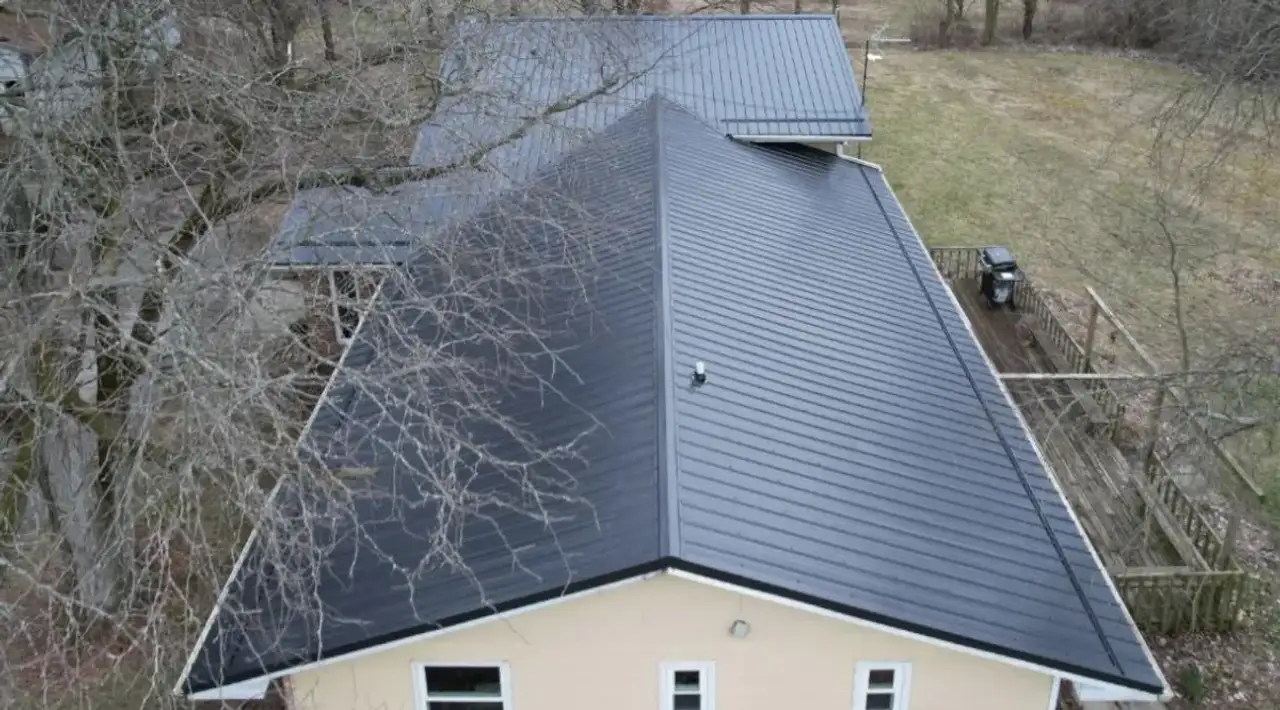
The homes along and behind 7th Street are compact early-to-mid-century frame construction with simple gable lines, which keeps a replacement at the low end of the ranges and makes the decision the common conversation here: another architectural asphalt cycle, or standing seam that outlasts the mortgage. The lots down where the North and South Forks of the Buffalo River meet carry the damp-morning shade of low ground, and the algae streaking that comes with it, so north-facing slopes there get the algae-resistant shingle lines the asphalt page describes.
Wind on the open ground and the farm steel south of town
Wind is the quiet, constant issue around Osseo. Sparse windbreaks on the open ground let gusts hit shingle edges and panel screw lines at full strength, so six-nail fastening on shingles and disciplined screw patterns on steel are standard practice on exposed sites, not upgrades. South of town, ribbed panel steel covers the working buildings, and the maintenance rhythm is the fastener gasket, which gives out years before the panels; re-gasket passes, storm-bent panel swaps, and full re-skins are routine runs, priced on the metal roofing page, with a 10 to 20% saving when the outbuilding shares a mobilization with the farmhouse. The 2025 hail reached the county’s edge, and while that event is past claiming, a roof nobody documented is a weaker claim next time, which the storm damage page explains.
No permit for a re-roof in Trempealeau County
Osseo delegates its dwelling-code permits to Trempealeau County, and the county’s fee schedule says it plainly: permits are not required for re-roofing, re-siding, or other repairs that are not required to meet current code. A city zoning permit only enters the picture when a building is structurally altered. The state dwelling code still applies to every house whether or not a permit is filed, and our installs are built to it, inspected or not. I-94 straight to exit 88 makes Osseo about 30 highway minutes from our shop, quicker in practice than closer towns on surface roads, and lead times follow the main calendar with storm work jumping ahead.
Every town we work in has a different permit rule, and they sit side by side on the roof permits page.