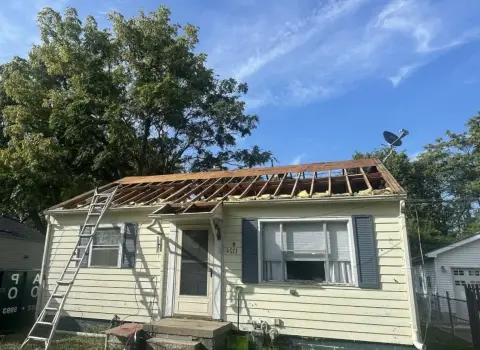

Most roof leaks aren’t “you need a new roof”, they’re a single failed flashing, a few missing shingles, or an ice-dam aftermath that needs targeted attention. This page covers scheduled repair work: the diagnose-quote-fix path for a roof problem that isn’t flooding your living room today. If water is actively coming in right now, skip to our emergency roof repair service instead, and if a storm caused the damage and insurance will be involved, start with the storm damage claims path.
For everything else: we diagnose what’s actually wrong before quoting work, and we’d rather quote you a $600 repair today than push a $14,000 replacement you don’t need yet.
Roof problems we repair
After a couple decades of working roofs across the Chippewa Valley, from the 1920s bungalows near Randall Park to the newer subdivisions on the south side, the same handful of issues account for the bulk of repair calls:
- Slow and intermittent leaks: the stain that shows up after heavy rain, often ten feet from where the actual leak is. Tracking down the source is the first job; the fix is usually small once you know where the water gets in.
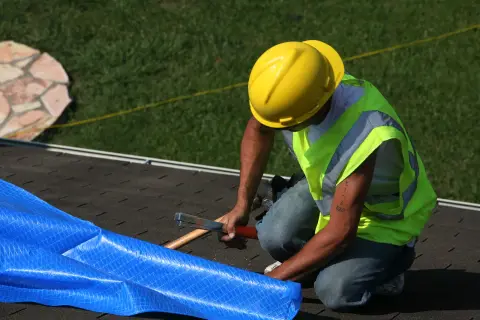
- Wind-lifted shingles: single shingles or whole rows torn loose, especially on older 3-tab roofs. The fix is replacing the lifted shingles and re-sealing the adjacent ones.
- Failed pipe boots and vent collars: the rubber gasket around plumbing vents dries out and cracks years before the shingles fail. One of the most common single-point leak sources on Wisconsin roofs.
- Cracked or lifted flashing: chimneys, skylights, sidewalls. Flashing is what fails first on a Wisconsin roof; the shingles outlast the metal.
- Valley wear: debris buildup, failed underlayment, ice-and-water-shield gaps. Valleys carry the most water on the roof; small problems become leaks fast.
- Nail pops: fasteners backing out through the shingle face from decking movement and freeze-thaw cycling. Each raised head is a future entry point, and a cluster of them signals a decking or ventilation issue worth a look.
- Ice dam aftermath: water that backed up under the lower shingle courses over the winter, showing up as ceiling stains near exterior walls once things thaw.
- Soffit and fascia damage: overflowing gutters tracking water back under the eaves and rotting the wood. Often fixed alongside the roof repair so cause and effect are addressed together.
- Animal damage: squirrels, raccoons, occasionally bats. Common at gable vents and weak eave details.
How we diagnose a roof leak
Finding a leak is the actual skill. Water travels, it can run down a rafter for ten feet before it shows up on a ceiling. We don’t recommend a fix before we know the cause. The diagnostic process:
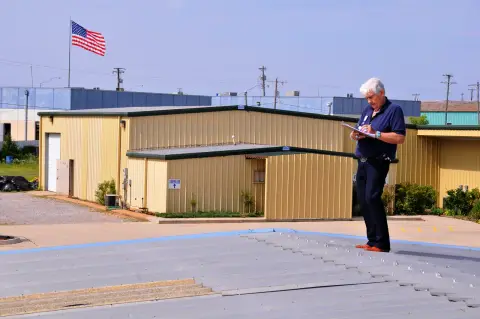
- Walk the roof to look for the obvious: missing shingles, lifted material, failed flashing, debris. More often than not, the failure is visible from above.
- Check the attic from below if needed, daylight visible through the deck, water staining on rafters or sheathing, insulation matting from past leaks. Often the attic tells you more than the roof.
- Water test if the source still isn’t clear, running a hose against roof sections one at a time until the leak reappears inside. Slow and methodical, but it works.
- Photo-document everything we find so the repair recommendation is backed up by evidence, and so you have a record of what we did.
How roof repairs are quoted
Repair quotes are written and specific, same as our replacement quotes. Common single-point failures (a run of shingles, a chimney flashing) get flat-rate pricing from the ranges below, confirmed on the roof before work starts. Repairs where the scope is genuinely unknowable until material comes up, like chasing rot under a valley, get a defined starting price and a conversation about what we find before the work grows. Every quote comes from someone who has actually walked your roof, includes photos of what we found, and stays good for a month. There’s no charge for the estimate visit and no obligation attached to it.
Roof repair vs replacement: the real math
We get this question at nearly every estimate visit. The honest framework:
- If less than a third of the roof shows wear or active failure and the rest is sound: repair.
- If your asphalt roof is 18-25+ years old and showing wear across the whole field, not just one spot: replace. Even targeted repairs will start failing elsewhere within a year or two.
- If you’re seeing multiple leak points in different parts of the roof: probably replace. Multiple failures usually mean the underlying material has run out of life.
- If the leak is flashing-driven (chimney, valley, plumbing vent) on an otherwise-sound roof: repair. Flashing fails before the field does, and we can replace the failed metal and leave the rest alone.
- If you’re going to sell the house within a few years and the current roof has realistic life left: repair. A sound twelve-year-old roof rarely kills a deal.
The arithmetic behind the framework: typical repairs on this page run $300 to $4,500, against $9,000 to $16,000 for an asphalt replacement on a typical Eau Claire home. On a sound mid-life roof, that gap is exactly why you repair. On a roof at the end of its life, the same gap is a trap: three separate $1,200 repairs across two seasons is $3,600 spent postponing a replacement that’s coming anyway, and none of it carries forward. When we think you’re on the wrong side of that line, we’ll say so in the written estimate.
Roof repair cost ranges
Real numbers for typical residential repair work in the Eau Claire area:
- Single-shingle replacement, small wind damage: $300–$500
- Step or counter-flashing repair (chimney, wall): $400–$1,200
- Valley repair with underlayment + ice and water shield: $1,200–$2,500
- Larger flashing or multi-spot repairs: $1,500–$3,500
- Ice dam damage requiring deck inspection and re-flashing: $800–$3,500
- Complex repairs involving framing or significant decking work: $2,000–$4,500+
The cost of putting off a roof repair
The drip you noticed last month started weeks before that. Water travels: it runs along rafters, soaks insulation, pools on top of drywall, and only shows as a stain when there’s enough volume to push through. Deferring a known repair is the most expensive form of roof maintenance there is.
What’s hidden behind a visible stain matters more than the stain. Wet insulation loses its R-value, so you pay to heat the outdoors all winter. Wet decking rots and grows mold. Wet drywall sags, then fails, and now the job involves paint, drywall, and sometimes framing. The predictable progression: what starts as a $500 repair caught early ends as a $4,000 multi-trade job once the ceiling and wall are involved.
Cathedral ceilings and finished attics make the timeline worse, because there’s no attic to inspect and the cavity insulation absorbs the leak silently for months. We see that pattern in older Eau Claire 1.5-story Cape Cods and finished bungalow attics every year. The simple rule: any water inside, even once, earns a scheduled inspection. The repair is cheap when it’s caught at the source, expensive when the source has been hiding behind the damage.
Ready for a look? Call (715) 245-5271 or use the form below to schedule a free repair estimate. We’ll walk the roof, show you photos of what we find, and give you a written number that holds.