
This page is about the insurance path. When a storm hits your roof, the repair itself is the easy part; the hard part is getting the damage documented, the claim filed, the adjuster’s scope right, and the money paid. That’s what we do, and the Chippewa Valley has given us plenty of practice: the April 28, 2025 tornado outbreak and the May 15, 2025 hail event across Eau Claire and Dunn counties each set off months of claims work in this market.
We’ve been documenting storm damage in Eau Claire long enough to know what insurance adjusters take seriously and what gets dismissed as wear and tear. We’ll inspect for free, tell you honestly whether you have a viable claim, and document everything you need to give your carrier. If water is coming in right now, that’s a different page: emergency roof repair handles the tarp and the clock, then the claim path picks up here.
What adjusters look for on a storm-damaged roof
An adjuster isn’t asking “is this roof damaged?”, they’re asking “does this damage match the storm being claimed?” The patterns matter, and they differ by peril, from pea-sized hail that bruises the mat to straight-line wind that creases whole tab rows:
Hail reads as random distribution. Strikes scatter across a slope without direction: round bruises on the shingle mat (soft spots that give when pressed), granule loss concentrated in gutters and downspouts, spider-cracking on aged shingles, and matching dents on soft metals like gutters, downspouts, and vent caps. Those soft-metal dents are the corroborating evidence adjusters check first, because shingles can be argued about and aluminum can’t. Severe hail (1.5”+ diameter) cracks shingles outright; smaller hail does cumulative damage across a season.
Wind reads as directional. Damage concentrates on the windward slopes and edges: lifted and creased tabs in rows, missing shingles with clean tear lines, flashing peeled from the same compass direction. The subtle version is the creased-but-attached tab, folded back by a gust and laid flat again. It looks fine from the ground and fails in the next event, and a good inspection documents every crease before the adjuster arrives.
Tree and branch impact is the most self-evident peril, but even a small branch resting on the roof usually means trapped water, scuffed granules, and bent flashing underneath. Don’t push a branch off yourself; what it drags with it becomes part of the claim.
Ice dam damage is the common winter claim in the Chippewa Valley. Water backs up under the lower shingle courses and shows up as ceiling stains near exterior walls. The damage is mostly inside the house, which is exactly why the documentation has to connect the interior stains to the roof-level cause, or the claim reads as a mystery leak.
Free storm damage roof inspection
Our storm damage inspections are genuinely free, with no obligation to use us for the repair. The process:
- Schedule a visit, usually within 1-3 business days of your call (faster for active leaks).
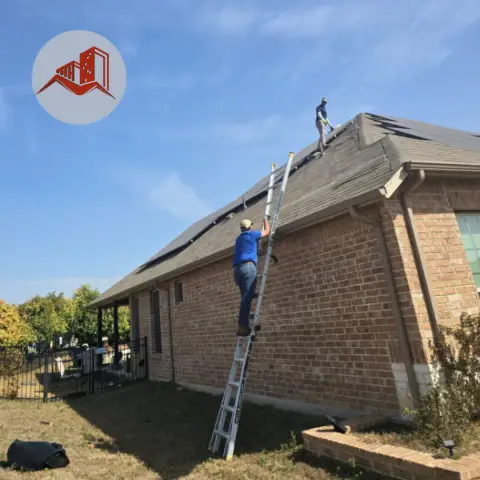
- We walk the roof if conditions allow, photograph everything we find, close-ups of damage, drone shots for context, gutter and downspout debris if there’s hail granule loss.
- We write up a damage report with our findings, including likely cause and rough scope of repair.
- You get a copy. If you’re filing a claim, that documentation goes to your insurance company.
- If you decide to use a different roofer for the repair, we still want you to have the inspection. Quality documentation makes the claims process smoother regardless of who eventually does the work.
Working with insurance
Roofing insurance claims have a predictable rhythm. Knowing what’s coming makes the process less stressful:
- You file the claim with your carrier (we don’t file for you, that has to come from the policyholder).
- The insurance company assigns an adjuster, who’ll typically schedule a roof visit within 1-2 weeks.
- We can be there for the adjuster’s visit. Strongly recommended, adjusters miss things, and our documentation gives them the full picture rather than a quick walk-around.
- The adjuster writes their scope of loss: what they think is covered and what they’ll pay for.
- If their scope misses things (extra dump fees, code-required upgrades like new ice and water shield, ventilation work that’s required because of code changes since the original install), we file a supplement to add those items. Most carriers expect supplements; it’s a normal part of the process.
- Once the scope is finalized, you get an ACV (actual cash value) check, the depreciated value of the loss minus your deductible. After the work is done, you get the RCV (replacement cost value) reconciliation check, which covers the depreciation.
We coordinate with you and the carrier through all of this. Our role is the on-roof expert; you’re the policyholder making the financial decisions.
When a roof claim is denied or underpaid
Denials and short scopes aren’t the end of the process; they’re a step in it. The escalation path, in order:
- Ask for the denial or scope in writing and match it against the inspection documentation. Most short scopes are missing specific line items (ice and water shield, code-required ventilation, dump fees), and most denials hinge on a wear-vs-storm judgment call.
- File a supplement with evidence. Photos tied to specific slopes and measurements beat adjectives. This resolves the majority of underpaid scopes, because carriers expect supplements as a normal part of the process.
- Request a re-inspection. You’re entitled to ask for a second adjuster visit, and we attend it the same way we attend the first, walking the documentation point by point.
- Use the appraisal clause if your policy has one. Many Wisconsin homeowner policies include an appraisal provision where each side hires an appraiser and disagreements go to an umpire. Slower, but it exists precisely for scope disputes.
- Complain to the state. The Wisconsin Office of the Commissioner of Insurance takes consumer complaints about claim handling, and carriers respond to OCI inquiries with more care than they respond to phone calls.
None of this is legal advice, and a public adjuster or attorney is the right call for a large disputed loss. What we provide is the documentation that makes every step above stronger.
Common insurance gotchas
A few things that catch homeowners off guard:
- Wear and tear isn’t covered. A 25-year-old roof showing widespread granule loss is at end-of-life, not damaged. We’ll tell you honestly which side of that line you’re on, and if it’s wear, a scheduled roof repair out of pocket usually beats a denied claim on your record.
- “Cosmetic damage” exclusions. Some carriers exclude purely cosmetic hail damage on metal roofs (denting that doesn’t compromise function). Read your policy or ask your agent.
- Deductible math. Some policies have flat deductibles, some have wind/hail-specific deductibles that are a percentage of dwelling coverage. A 1% deductible on a $300,000 home is $3,000, not the standard $1,000 most folks expect.
- Don’t sign over benefits to anyone. Some storm chasers ask homeowners to sign an “Assignment of Benefits” giving the contractor the right to collect insurance proceeds directly. That’s how you end up locked into using one specific roofer. We don’t ask for AOBs and you shouldn’t sign one without legal advice.
Roof claim timeline after a major storm
After a major hail or wind event, expect roofing demand to spike across Eau Claire. Rough order of operations:
- Tarp anything actively leaking before the next storm; our emergency roof repair service exists for exactly this step.
- Call your insurance company to file the claim. Note your claim number; you’ll reference it constantly.
- Get a local inspection (us, or someone else established). Avoid the door-knocking crews.
- Wait for the adjuster. This is the slow part: 2-6 weeks during a major event season.
- Once approved, schedule the repair. Our schedule fills fast after hail events; expect 4-8 weeks out during peak season, less in shoulder seasons.
Active leaks can’t wait six weeks; the emergency page covers how tarp service jumps the queue. For the claim itself, call (715) 245-5271 and we’ll figure out the right next step on the phone.
What to do in the first 48 hours after a storm
The hours after a major storm are where insurance claims are won or lost. A short checklist for the day-of and day-after.
Stay off the roof. Wet shingles, broken branches, and adrenaline are a bad combination. Damage assessment from the ground is fine; getting up there yourself is rarely worth the fall risk.
Document what you can see. Walk the perimeter of the property and photograph the yard, anything from the storm visible from your driveway, neighbors’ damage if visible (it reinforces the storm event for your carrier), debris patterns. From inside, photograph any ceiling stains, water marks, daylight visible through the attic, anything that wasn’t there before.
Tarp anything actively leaking. If you can do it safely from inside (covering ceiling fixtures with plastic, putting buckets out), do that. If the leak needs roof-level intervention, that’s an emergency roof repair call, and it’s dramatically cheaper than the damage that compounds while waiting.
Call your insurance before you call a contractor. Get a claim number and the adjuster contact info on file. Filing within 24-72 hours anchors the timeline; filing two weeks later opens questions about whether the damage occurred during the original storm.
Schedule inspections within 1-2 weeks. Insurance adjusters take 1-3 weeks to come out during major event seasons; you want a contractor’s documentation in hand when the adjuster arrives.
Don’t sign anything an inspector hands you on the spot. Particularly an Assignment of Benefits, that hands the contractor your insurance proceeds directly and locks you into them, with limited recourse if the work is bad. Real contractors don’t ask for AOBs.
Keep all receipts. Tarp service, hotel if displaced, food spoilage if power was out, all may be covered under your policy’s additional living expense coverage.